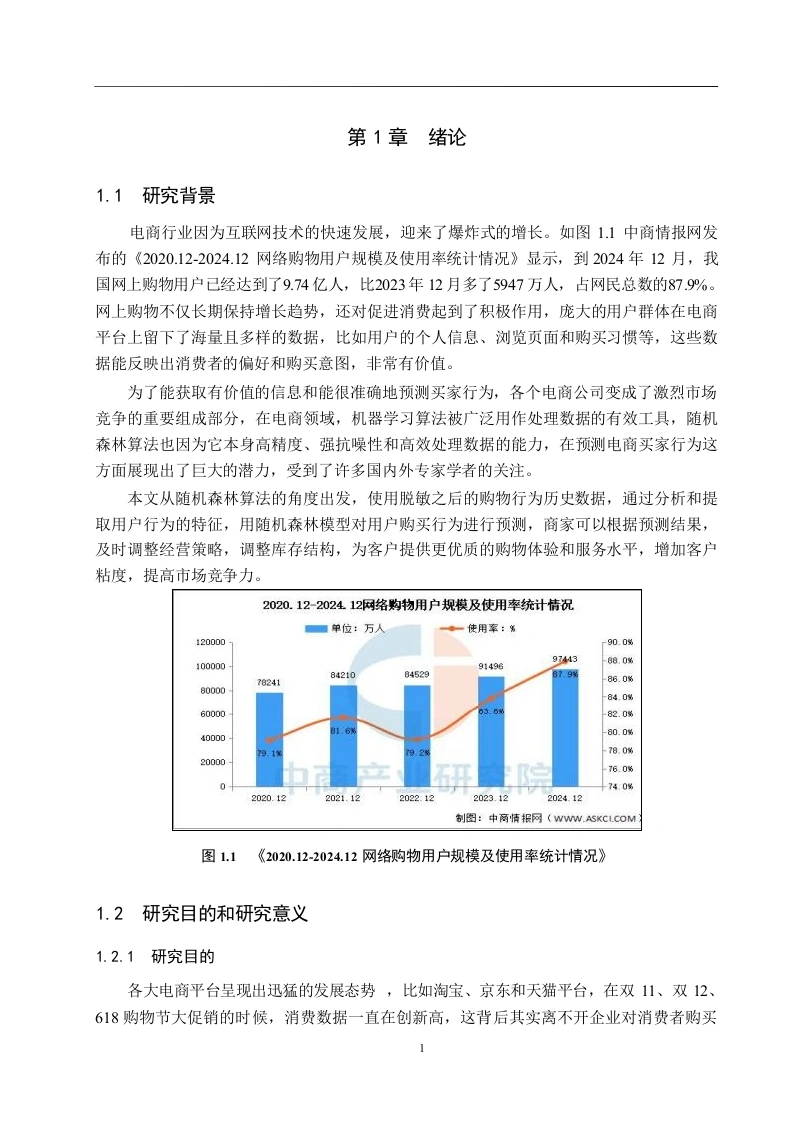
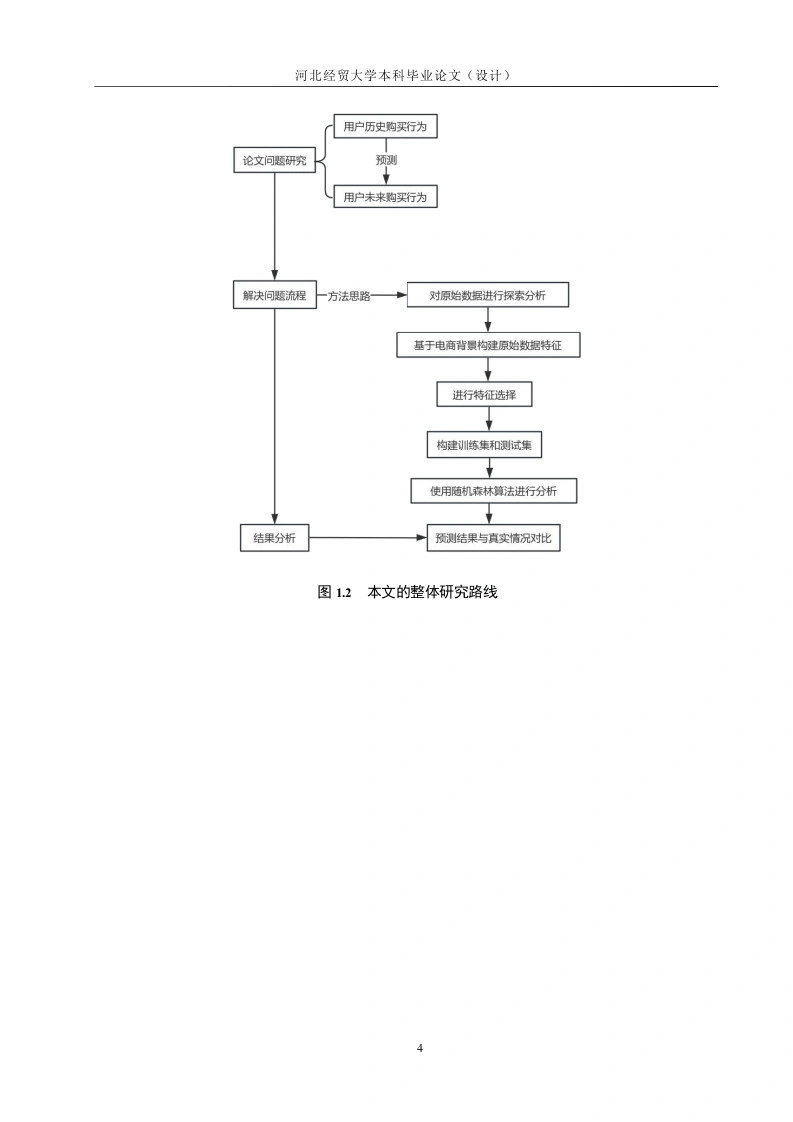
随机森林算法在电商用户购买行为预测中的应用研究摘要随着互联网技术的快速发展,电商行业迎来了巨大的发展机会,电商用户的快速增长为平台创造了巨大的经济效益同时也带来了新的挑战,商家如何减少营销成本并增加经济效益,电商平台和商家怎样才能提供准确和有效的商品信息,从而满足用户的消费需求,这篇文章侧重于随机森林算法在电商用户购买行为预测领域的应用研究。研究使用的主要编程语言是MATLAB,选择了Newsletter Subscription”作为研究的主要目标变量,这样就把研究问题变成了一个二维分类问题。利用处理之后的电商用户数据,通过对连续变量进行ANOVA分析和对离散变量进行卡方检验筛选出和目标变量相关度较高的关键特征,这样能提高模型的性能,然后创建随机森林分类模型并进行评估。随机森林模型的准确率是68.3%,精确率是63.5%,召回率是75.7%,1值是69.1%。该研究证明了电商公司可以构建随机森林模型对用户购买行为进行预测,根据结果制定准确的营销策略、调整库存情况并增加经济效益提供了强有力的技术支持,这对电商行业的未来发展很重要。关键词:随机森林算法:电商用户:购买行为预测IABSTRACTContinuously the rapid development of Internet technology,e-commerce has very largeamounts of industry,e-commerce growth opportunities a rapid increase in the number of usersthat have been made to e-commerce platforms the economic benefits but also new challenges,These challenges contain e-commerce platform providers and how you go about accurate andeffective information,and how to identify potential customers and offer them service solutionstailored to their profile in order to meet their personalized consumption needs.This article ismainly devoted to the study of the application of the random forest algorithm in the field ofpredicting the buying behavior ofe-commerce users.The MATLAB programming language was used for this study.The target variable"Newsletter Subscription"has been deliberate.This target variable refers to the presence or notof a subscriber to a notification campaign,thus turning the research question into atwo-dimensional classification problem.After processing,the e-commerce user data can bescreened out by ANOVA analysis of continuous variables and chi-square test of discretevariables to screen out the key features with high correlation with the target variables,so as toimprove the performance of the model,and then create a random forest classification model andevaluate it.The accuracy of the Random Forest model was 68.3%,the precision was 63.5%,the recallrate was 75.7%,and the FI score was 69.1%.This study demonstrates that e-commercecompanies can use the prediction results of the Random Forest model to develop accuratemarketing strategies,optimize product recommendations,identify potential customers,andprovide them with personalized services.This provides strong technical support for the futuredevelopment ofthe e-commerce industry.Key words:random forest algorithm;e-commerce users;purchasing behavior predictionI目录第1章绪论1.1研究背景…1.2研究目的和研究意义1.2.1研究目的:1.2.2研究意义.21.3研究现状.21.4研究内容3第2章相关技术基础…5第3章电商用户购买数据预处理73.1研究问题描述073.2数据描述…73.3数据处理8第4章电商用户购买行为的特征研究4.1特征选择理论基础94.2特征分析和特征选择。9第5章基于随机森林模型的电商用户购买行为预测…155.1实验前期准备155.1.1模型评估指标…155.1.2数据集划分155.2随机森林分类模型概述155.3模型预测结果分析16结论…17参考文献g致谢.cacccocc-cccc-ccc-cccc-ccm20Ⅲ第1章绪论1.1研究背景电商行业因为互联网技术的快速发展,迎来了爆炸式的增长。如图1.1中商情报网发布的《2020.12-2024.12网络购物用户规模及使用率统计情况》显示,到2024年12月,我国网上购物用户已经达到了9.74亿人,比2023年12月多了5947万人,占网民总数的87.9%。网上购物不仅长期保持增长趋势,还对促进消费起到了积极作用,庞大的用户群体在电商平台上留下了海量且多样的数据,比如用户的个人信息、浏览页面和购买习惯等,这些数据能反映出消费者的偏好和购买意图,非常有价值。为了能获取有价值的信息和能很准确地预测买家行为,各个电商公司变成了激烈市场竞争的重要组成部分,在电商领域,机器学习算法被广泛用作处理数据的有效工具,随机森林算法也因为它本身高精度、强
暂无评论内容